What's Hot: Offices, Housing, Hotels? Plan B Floated For Remaining Parcels At DC's Reservoir District
 DC: The Country's Priciest Housing Market in 2012
✉️ Want to forward this article? Click here.
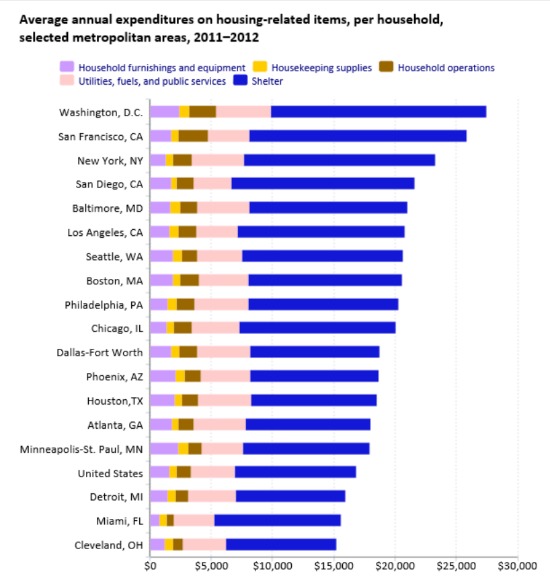
A new report from the Bureau of Labor Statistics (BLS) looks at the impact the Great Recession had on different aspects of the housing market, with some interesting insight into the frequently-referenced resiliency of the DC market.
First up: DC was the most expensive housing market in the country compared to other metros in 2011-2012. The amount area residents spent on furnishings, supplies, utilities, household operations and housing itself eclipsed the next-priciest metro, San Francisco, by about $1,000 a year.
The national average at the time was $16,887. According to the report, “Households in Washington D.C ($17,603) spent, on average, almost twice as much on shelter — a component of housing expenditures — than households in Cleveland, Ohio ($9,061).” Time to pack up for Ohio, kids!
The report also used 2012 data to look at the difference between renting and buying. On average, renters spent more than owners on the base cost of housing (for renters, that was the rent paid; for owners, that was the mortgage and interest), but when you factor in other owning expenses, like maintenance, repairs and more, homeowners spent $1,788 compared to renters’ paltry $13 average outlay on those same expenses. The report does not say whether that cost difference made renting a better deal than owning on average, but the calculus is usually very market-dependent.
Below is a chart that tracks owner’s outlays on mortgage payments and utilities during the recession.

Finally, the report looked at the impact of the recession on housing-related industries, like construction, which took a big hit nationwide.
But the prediction is that between 2012-2022, employment across those industries will pick up dramatically. Jobs in “masonry contractors (65.3 percent); residential building construction; poured concrete foundation and structure contractors; electrical contractors and other wiring installation contractors; and plumbing, heating, air-conditioning contractors are projected to grow at least 28 percent.”
See other articles related to: bls, bureau of labor statistics, great recession, housing
This article originally published at https://dc.urbanturf.com/articles/blog/how_housing_costs_changed_after_the_great_recession/8944.





UrbanTurf Listings showcases the DC metro area's best properties available for sale.

Most Popular... This Week • Last 30 Days • Ever
A look at the closing costs that homebuyers pay at the closing table.... read »
The plan unveiled Sunday for East Potomac Golf Links would make the course a very dif... read »
Trammell Crow is looking to modify options for two parcels at the former McMillan San... read »
Higher mortgage rates took a toll on the DC-area housing market in September, as buye... read »
High Street Residential’s plans for a prominent corner in Shaw will have to wait a ... read »

- How Do Closing Costs Work in DC
- A Very Different East Potomac: What Trump’s Plan Would Build on Hains Point
- Offices, Housing, Hotels? Plan B Floated For Remaining Parcels At DC's Reservoir District
- The 5 Most Telling Stats For The DC-Area Housing Market
- 230-Unit Shaw Project Needs More Time to Get Off the Ground
DC Real Estate Guides
Short guides to navigating the DC-area real estate market
We've collected all our helpful guides for buying, selling and renting in and around Washington, DC in one place. Start browsing below!
First-Timer Primers
Intro guides for first-time home buyers
Unique Spaces
Awesome and unusual real estate from across the DC Metro
