 Report Reveals DC's 43 Walkable Urban Places
✉️ Want to forward this article? Click here.
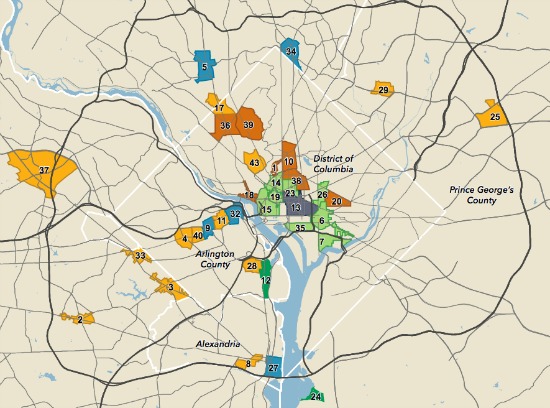
The DC area’s WalkUPs. Courtesy of the report.
George Washington University professor Chris Leinberger believes that the DC area is doing urban development right.
“All of my research kept on showing that metro DC was the model — this is where the country was heading,” he said to a large crowd at George Washington University’s Jack Morton Auditorium.
On Tuesday, The Urban Land Institute, in collaboration with George Washington University, hosted a conference in honor of Leinberger’s recently released report: DC: The WalkUP Wake-Up Call. The Nation’s Capitol as a National Model for Walkable Urban Places. The day started off with a panel about the report, and the rest of the day’s schedule featured discussions inspired by Leinberger’s report.
In the report, Leinberger identified 43 Walkable Urban Places (WalkUPS) in the region, and then examined them to find out how they have evolved, what they are comprised of, and what the economic data reveals. These areas are relatively small — around 400 acres — and can be divided into six categories: downtown, downtown adjacent, urban commercial (like H Street and Georgetown), suburban town centers, strip commercial redevelopments (like Tyson’s Corner and Wheaton) and greenfields (planned communities that emerge whole, like National Harbor).
Here are a few facts that Leinberger dug up:
- Rental apartments are making a move into WalkUPs. In the 1990s, 12 percent of the region’s apartment space was in these areas; today, the percentage is 42.
- Retail, though growing, lags behind apartments. Today, 13 percent of the region’s retail exists in WalkUPs, up from 8 percent in the 90s.
- Suburban office parks used to draw a higher rent than urban buildings; now that relationship has reversed.
- Housing prices have also flipped; twenty years ago, McLean boasted a higher price per square foot than West End; today, West End wins out.
Tysons Corner and White Flint, which are both in the process of switching from suburban models into walkable urban places, are very significant and will be interesting to watch, thinks Leinberger. “We will see three or four walkable spaces emerge from Tysons Corner,” he predicted.
During the panel, economist Richard Green brought up a couple critiques of Leinberger’s report. He noted that DC’s growth and recent success cannot just be tied to its walkable structure, crediting Mayor Anthony Williams, among others, with rejuvenating the city. He also wondered if all areas need to satisfy every age group; while the District is great for those in the 20s, 60s and 70s, he thought, maybe the city shouldn’t work so hard to make itself desirable to people in their 30s and 40s, who perhaps need better schools and more parking, both of which are offered in the suburbs.
Check out the full report here.
See other articles related to: smart growth, urban land institute, walkability
This article originally published at https://dc.urbanturf.com/articles/blog/report_reveals_dcs_43_walkable_urban_places/6010.





UrbanTurf Listings showcases the DC metro area's best properties available for sale.
Most Popular... This Week • Last 30 Days • Ever

UrbanTurf is re-publishing an article with updated links that is a step-by-step way t... read »

The images recently filed with DC's Historic Preservation Office show the vision for ... read »
A sprawling new residential community has been pitched in Clarksburg.... read »

The bill would crack down on digitally altered and AI-generated photos in rental and ... read »
The September housing market report from Bright MLS finds that sales in the DC were d... read »




- How to Obtain a Basic Business License For Your DC Rental
- Renderings Reveal The Look For DC's Latest Alley Development
- Developers Float 689-Home Community Next to I-270 in Clarksburg
- What You See May Not Be What You Get: DC Bill Takes Aim at AI-Edited Listing Photos
- With Rates To Blame, The Fall Housing Market Gets Off To A Slow Start In DC Area
DC Real Estate Guides
Short guides to navigating the DC-area real estate market
We've collected all our helpful guides for buying, selling and renting in and around Washington, DC in one place. Start browsing below!
First-Timer Primers
Intro guides for first-time home buyers
Unique Spaces
Awesome and unusual real estate from across the DC Metro
