This Week’s Find: The DC Area’s First Passive Design House

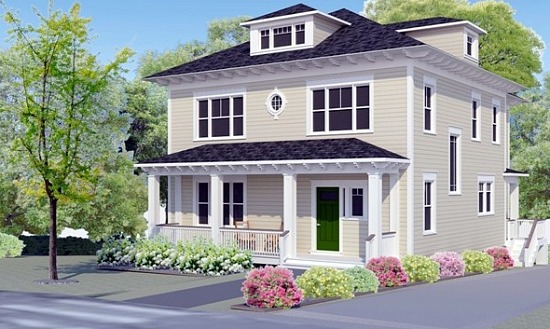
Rendering of 4717 North Chelsea Lane
More and more these days, architects and builders across the DC area are focusing their attention on USGBC’s LEED Platinum standards in an effort to distinguish themselves from the rest of the industry who are still building according to code.
One such example of this trend is the DC area’s first Passive House, a five-bedroom, 4.5-bath home being designed in the Glenbrook Village section of Bethesda by Alexandria-based David Peabody Architects.
At first glance, the home appears to be missing the array of solar and thermal panels that have become trademarks of green homes. The house also will not have a furnace. As a home buyer, you might be worried about these items missing from your newly appointed “green” home, however Peabody says that’s all part of the design of a Passive Home.
Passive House design focuses on constructing a super-insulated building structure with a building orientation that offers a good amount of south-facing triple-glazed glass, and an air exchanger that brings in conditioned fresh air to the home. The idea is to build a more energy-efficient home from the outside, and consequently reduce heating and cooling costs drastically, eliminating much of the need for what can be expensive solar and geothermal systems. (For a more detailed explanation of how passive design works, click here.)
Building a home in this region without a furnace firing away every 10 minutes during the winter, though, seems like a bad idea. However on a recent 38-degree day, the work-in-progress registered a pleasant 68 degrees inside thanks to the passive design. (Eventually, a heating/cooling pump will be installed to control cooling and heating the home as well.)
When complete, the 4,500 square-foot home is expected to use 90 percent less energy per square foot than a comparable existing home in the region.
“A house the same size with a 100 HERS** rating would have about $2,900 a year in energy costs,” Peabody explained. “This home will have costs of about $725.”
The home at 4717 North Chelsea Lane (map) will hit the market by mid-spring for $1.689 million. For more info, contact David Peabody Architects.
(***HERS (Home Energy Rating System) is a rating system developed to measure how efficient a home performs. A home that is up to code has a HERS rating of 100.)
Michael Kiefer operates Green DC Realty, a business that focuses on DC’s expanding green building market.
Similar Posts:
See other articles related to: this weeks find, green real estate dc, bethesda
This article originally published at http://dc.urbanturf.com/articles/blog/this_weeks_find_the_dc_areas_first_passive_design_house/3005
Join the discussion
Most Popular... This Week • Last 30 Days • Ever
The Mint, a new 21-unit condo project from PERS Development at 4th Street and Rhode... read »
Neighborhood Profiles more »
Kalorama: A Posh View From Embassy Row
Shilpi Paul
May 11th | 4 Comments
The small neighborhood of Kalorama emerged during a period of rapid development in DC's history,... read »
Editor's Choice more »
DC Area Home Prices Rise 11.2 Percent
Shilpi Paul
May 10th | 7 Comments
DC area home prices rose 11.2 percent in April, the largest increase for prices in almost six... read »
New Condo Profiles more »
New Boutique Condo Project Hits the Market in Columbia Heights
UrbanTurf Staff
April 24th | 1 Comment
A new 5-unit condo project hit the market in Columbia Heights today from the same developer that... read »
The DC Condo Market more »
Abdo Returns to Logan With 30-Unit Project
UrbanTurf Staff
May 2nd | 8 Comments
Developer Jim Abdo made his name in Logan Circle, and is now returning to the neighborhood with a... read »
Green Real Estate more »
Should DC Follow LA in Teaching Residents How to Green Their Homes?
Shilpi Paul
May 7th | 2 Comments
While LEED certification is quickly becoming standard for new buildings in DC, residents in the... read »
Deal of the Week more »
Deal of the Week: Georgetown on the Cheap
UrbanTurf Staff
May 8th | 1 Comment
Georgetown is known for a lot of things, but reasonably priced homes for the mere mortal is not one... read »
Renting more »
Lovely: Making Apartment Hunting Less Painful
Shilpi Paul
3:45 PM EDT | 3 Comments
Tired of scrolling through the minimalist, black and white Craigslist interface when searching for... read »
Market Watch more »
Market Watch: Logan Circle, Columbia Heights, Dupont Circle
Keith Gibbons
November 28th | 5 Comments
Housing Market Watch returns this week after a little hiatus as Keith Gibbons takes a closer look... read »
Unique Spaces more »
This Week’s Find: From Pie to Hooch to Heroin to Home
Shilpi Paul
March 28th | 7 Comments
Built in 1860, This Week's Find has a past that includes life as a pie factory and clearing house... read »
This Week's Find more »
A 33-Foot Wide Living Room in Kalorama
Shilpi Paul
May 17th | 2 Comments
In This Week's Find, we take a look at a home whose layout reaches into the house next door. ... read »
UrbanTurf Reader Asks more »
Do I Deserve Financial Compensation?
UrbanTurf Staff
May 7th | 11 Comments
In this installment of UrbanTurf Reader Asks, a reader who recently moved into a rental building in... read »
What X Buys You more »
What $330,000 Buys You in DC
Shilpi Paul
May 16th | 6 Comments
In What X Buys You this week, UrbanTurf takes a look at properties on the market in the $325,000 to... read »
Best New Listings more »
Best New Listings: A Tudor, A Co-op and Chocolate Mint in the Garden (Week of May 18th)
Shilpi Paul
May 18th | 0 Comments
In this week's edition of Best New Listings, we look at a Tudor tucked away off 16th Street, a... read »
- Best New Listings: A Tudor, A Co-op and Chocolate Mint in the Garden (Week of May 18th)
- Best New Listings: Georgetown, Kent and Logan Circle (Week of May 11th)
- Best New Listings: Deceptive Facade, High Tech Renovations and a Beautiful Backyard (Week of May 4th)
- Best New Listings: Dupont Dog Owner, The Turret House, 1927 Craftsman (Week of Apr 27th)
- Best New Listings: Petworth Wardman, Carly Simon Condo and a Light-Filled Row House (Week of Apr 20th)
Luxury Real Estate more »
The Priciest and Largest Plot of Land in DC Hits the Market
UrbanTurf Staff
May 18th | 2 Comments
UrbanTurf has learned that a 1.25 acre plot of land has hit the market in Cleveland Park, making it... read »


12 Comments
Thanks for the post and the interest in our project! I just want to clarify with regard to the comment about LEED Platinum…
The Passive House program is both a third party building certification (nearly 30,000 projects now certified in Europe) and a methodology for building affordable super-efficient buildings. Passive House certification focuses ONLY on energy and interior air quality, so it is complementary to, not in competition with, LEED. We chose to go for Passive House certification on this project because our primary goal was energy efficiency. While we would have liked to go for LEED as well, we did not have the budget to pay the $4,000 in administrative costs for LEED certification. There have, however, been a number of projects certified for both Passive House Standard and LEED Gold and Platinum. In fact, I have heard that Passive House and the USGBC have been in conversation about providing joint certification, where the maximum LEED points for energy and IAQ would be automatically awarded to any house achieving Passive House certification.
We are doing this New American Foursquare as a joint venture with O’Neill Development, located in Gaithersburg. It is the prototype for a suite of houses in this stye, as well as smaller ones in the bungalow style, all built to the Passive House Standard and designed to be competitive with market rates and affordable to the middle class. Stay tuned to our blog (http://dcpassivehouse@greenhaus.org) for posts on this. We will be offering to build these houses on owner’s sites throughout the DC metro area, and offering the plans to qualified builders nationwide.
I’ve visited this house a number of times as another spec homebuilder/Passive House designer in the D.C. area. I was there for the first blower door test. The people involved did such a great job on air sealing, the results came within Passivhaus standard even without drywall! I was very impressed. Passive houses are beginning to be built in various parts of the country in all different styles. The O’Neill/Peabody house is an example that an ultra energy efficient home can be built without sacrificing the aesthetics. The technology exists, the materials are available, let’s build more of them.
Great article! I agree more builders should integrate passive design concepts, especially for new construction. Can anything be done for existing construction to integrate passive concepts?
I found an interesting article on Wikipedia on Zero-energy building. In many developing countries the concept has been integrated for ages out of necessity. We can learn a lot from these building concepts and see how they can be integrated into modern building practices.
“Traditional building use consumes 40% of the total fossil energy in the US and European Union.[1][2] In developing countries many people have to live in zero-energy buildings out of necessity. Many people live in huts, yurts, tents and caves exposed to temperature extremes and without access to electricity.”
http://en.wikipedia.org/wiki/Zero-energy_building
In my earlier post I mistyped the url of the blog we have created to cover the project. Correct url is http://passivehouse.greenhaus.org/
Roger Lin wrote: [The technology exists, the materials are available, let’s build more of them.}
Nice sentiment - but how many potential buyers are there which can afford $1.689 million, or $375/sf including land costs? I’d be very interested in building a passive house or net zero-energy green home on my lot in the $200-250/sf range (excluding land, water/sewer hookup, landscaping)—has passive house building become that affordable yet?
When I was young my parents had the foresight to build their home with good southern exposure and proper windows. We could always count on well-lit and warm rooms during the winter.
In the years since then I have often enjoyed comfort and lower utility use because of well-placed windows and good building orientation. Simple designs have worked well in my experience.
It is very interesting to read how these builders have taken things to a new level. The use of air exchangers is intriguing.
I found some good resources for further study of passive solar design and have posted them to a page on my Web site
http://globalresourcesnews.com/passivesolardesign.php
Best luck with the project.
I would like to add couple comments to this conversation. I am working with “Intus Windows” (energy efficient windows for passive homes, http://www.intuswindows.com ) and I went to Passive House training provided by Passive House Institute US so I have some inside information
.
I visited David’s house few times. And it is really amazing. It features classical design which blends with neighborhoods architecture and best features of the Passive House such as extreme energy efficiency, comfort, quality air. Another very important feature for urban living is noise elimination from the living quarters. You would be amazed how quite this home is. All this could be achieved thanks to Passive House design and great architects, consultants and builders such as David Peabody and O’Neil developers.
To add to John’s Sener comment about the affordability of Passive House. It can be done without braking a budget. Last year we visited few homes in Portland, OR area and on one of the homes was build by local builder who is big fan of Passive House. The couple who bought the home paid around 300 K. The house was around 1400 SF. Probably it will cost little more in DC area but it can be done.
Passive House fans are welocme to join Passive House club at link below. This is official meet up site for the Mid-Atlantic-Passive -House-Alliance chapter.
http://www.meetup.com/Mid-Atlantic-Passive-House-Alliance
To John Sener;
John, I am not aware of any passive or net zero homes across the DC area in the price range of $250/sq’. As you can understand land sells for a premium around here and especially inside the District nothing comes cheap since there are so few parcels available as compared the suburbs. What I can say is that many of the spec builders who are putting up some of these amazing examples of what is possible with advanced practices would like to build homes in the $500k range as it would open up their markets quite a bit. The challenge thus far for many of them has been what will a consumer pay for as a home buyer and what will the home appraise for on a loan.
It is quite a risk to be building spec homes in this market and many of the green builders I have worked with over the years have the past year and half moved into high end renovations as the risk was too much although I am now seeing more of them jumping back in looking for opportunity to build this Spring.
I believe the Passive House is a great example of what green needs to focus more on, the building envelop and construction practices rather than “systems” to make up for the loss in energy we more often than not have to deal with in our homes.
A clarification on costs: The construction cost is not what makes the Chelsea Lane house expensive; it is the land cost. We can build this same house on any site in the DC area for $230/ft. In fact, this house is designed as a prototype for doing just that. We have developed several versions of this house, from 3 to five bedrooms, which we will be building on client’s sites, customized for their needs, in MD, DC and Northern VA.
And remember this house is being built for sale in a part of Bethesda where I bet there’s a lot money invested in premium interior details (appliances, finishes, built-ins) and exterior landscaping (in addition to the land costs) which will push the sq ft costs higher, yet don’t play a role in passive house design efficiency. In a different market, for a different audience (yourself?), you can build just as efficiently and be cheaper.
(Note that as you decrease the house size there’s a tendency to increase per sf cost. A 4500 sf home with 4.5 baths, has 1 per 1000 sf. There’s a good chance that 2500 sf house will have at least 3 baths, equal to more than 1 per 1000 sf. With tile, plumbing and fixtures of baths being more expensive per sf than big rooms with a closet, you’ll likely raise the cost per sq ft when building smaller.)
It is fabulous to see an example of a passive house being built in the area. The idea of a house not having a furnace, I would bet, keeps more builders away from the idea of a passive house (out of fear that buyers will shun it) than the cost. However, a few good examples will go a long way to demonstrate that a passive house makes a lot of sense.
We had a solar hot water system installed when we renovated several years ago, and our builder was very leery of there not being a traditional water heater in our house “just in case” and, in his mind, to keep the house sale-able. But, like the passive house with a back-up heating/cooling pump, our solar system has a back-up electric heating unit in the solar water tank. We turn it on about 18-25 days a year, and that’s all we need it. For the passive house, if there’s a truly unseasonable cold snap, the heat pump can be turned on. But I’d bet it will be needed for heat less often than we turn on our solar back-up.
It sounds like a really nice project. I wish they would build houses like that near me.
My husband and I have agreed that we will try to make our house more energy efficient. We have decided to start with new windows and after that a heating pump.
I have searched and found a lot of websites that sell windows for passive houses, but I have doubts about quality. Do some of you have experience with Rational composite windows?(AURAPLUS) I can see on their website that they’ve made a lot of passive house projects.
Thank you
Regards
Angela