Rent Vs. Buy: The 32 Year-Old Journalist

A couple weeks ago, UrbanTurf took a test drive of the Rent vs. Buy calculator from The New York Times, perhaps the most-used internet tool when people are attempting to make a calculated decision to purchase a home.
That exercise was so well-received by our audience that we decided to make it a regular part of our editorial stream.
A quick refresher as to how the calculator works. Users input their monthly rent and their desired home price point, in addition to a slew of variables like down payment amount, probable mortgage rate, property taxes, condo fees and the rate of home value appreciation and rent increases in their area. The calculator then creates a graphical representation of the time it takes for one to break even on their investment, and the return on that investment going forward. The calculator also lets you compare figures across a theoretical number of years lived in the property, so you can see the cumulative savings or loss.
The tool is not perfect, though, primarily because it does not allow you to enter a variable home price appreciation or rent increase percentage. In other words, if a user enters a home price appreciation rate of 5 percent a year, that level of appreciation is assumed for the entire period of the loan.
Our first test case was a young woman who was putting 10 percent down and using conventional financing. This time around, we tested a man looking in a lower price point who used FHA financing. The differing break even points for each case are notable. In short, the break even point is much farther out if a buyer goes the FHA route.
Check out our new potential buyer (based on a friend of UrbanTurf) and the three different scenarios, based on varying home price appreciation and rental rate changes, below. If you want to give the calculator your own test, click here, and if you want us to include you as our next subject, email us at editor2013@urbanturf.com.
Patrick — 32-year-old journalist living in Shaw
Patrick pays $1,500 per month to rent a 700-square-foot one-bedroom apartment in Shaw. He’s looking for a comparable space in the same area, where similar units cost about $350,000. His savings are not too deep, but he feels that he could come up with a down payment of 3.5 percent, or $12,250 in this case, for an FHA-backed mortgage with an interest rate of 3.9 percent.
Here are some of the other variables that we incorporated into the scenarios below:
Scenario #1
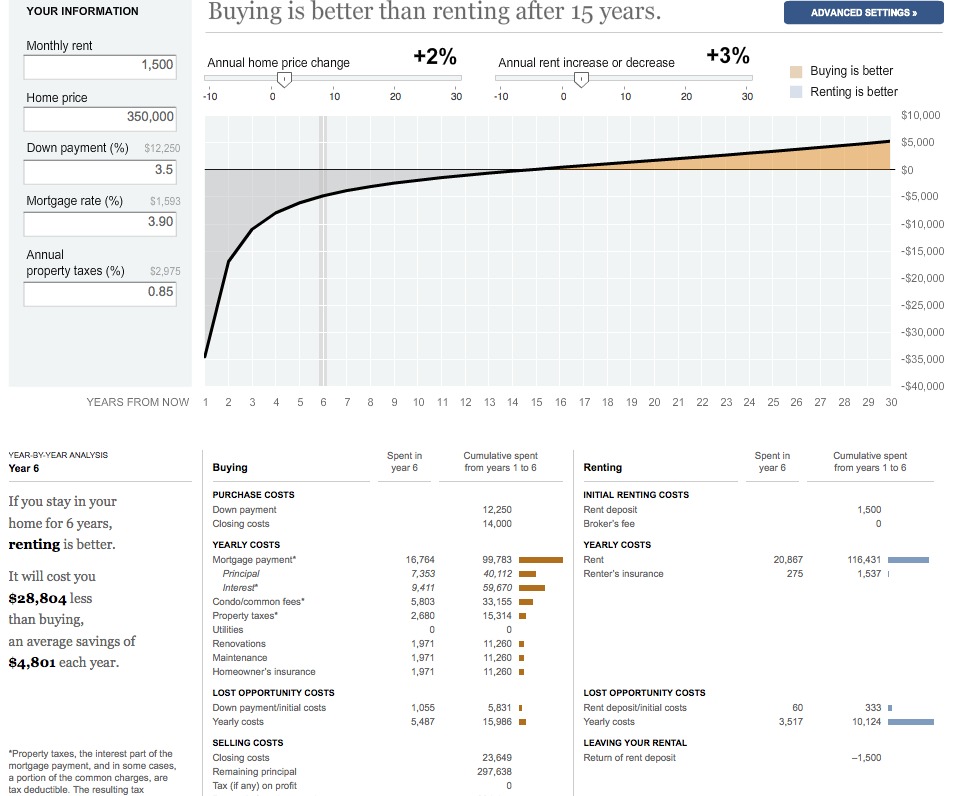
Our first scenario assumes a home price appreciation of 2 percent a year, and a rental rate increase of 3 percent a year. Assuming these numbers, it would take Patrick about 15 years to break even on his investment, according to the calculator. A graphical representation of the rent versus buy breakdown for this scenario can be seen below.
Scenario #2
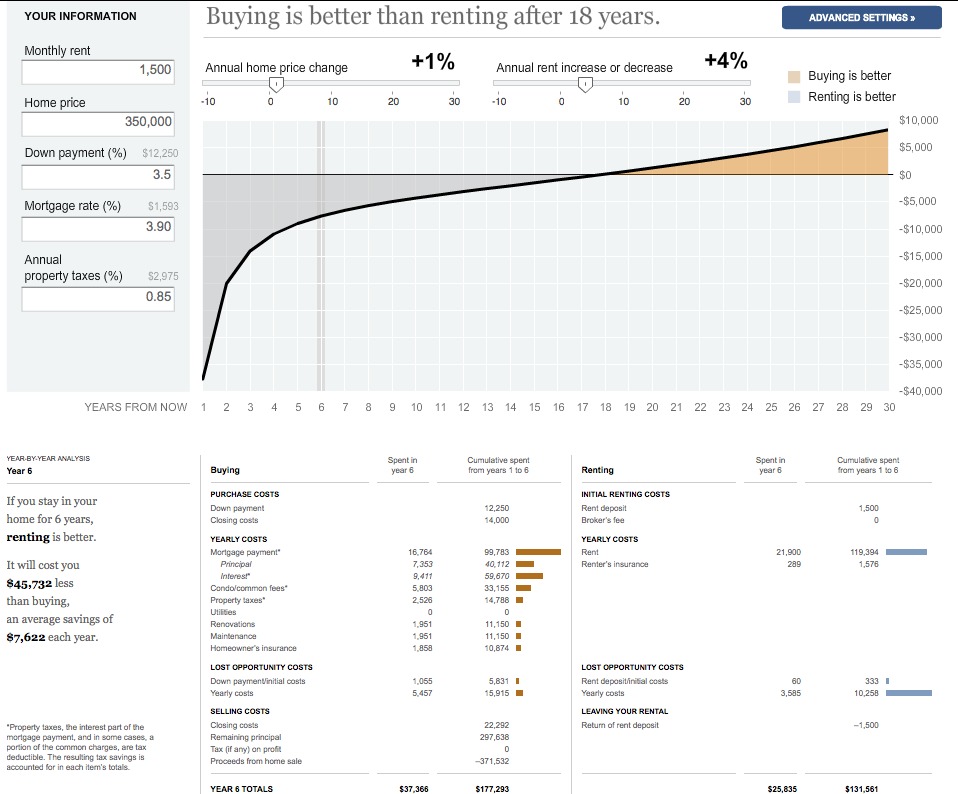
Our second scenario assumes a home price appreciation rate of 1 percent a year, and a rental rate increase of 4 percent a year. Assuming these numbers, it would take Patrick 18 years to break even on his investment, according to the calculator. A graphical representation of the rent versus buy breakdown for this scenario can be seen below.
Scenario #3
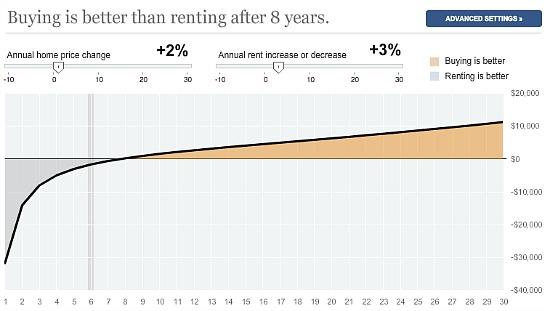
Our third scenario assumes a home price appreciation rate of 3 percent a year, and a rental rate increase also of 3 percent a year. Assuming these numbers, it would take Patrick about eight years to break even on his investment, according to the calculator. A graphical representation of the rent versus buy breakdown for this scenario can be seen below.
See other articles related to: renting in dc, rent vs buy
This article originally published at http://dc.urbanturf.com/articles/blog/rent_vs_buy_32_year_old_journalist/6785
Join the discussion
Most Popular... This Week • Last 30 Days • Ever
A few days ago, we reported on the zip codes in DC and the larger metro area where... read »
Neighborhood Profiles more »
Trinidad: The Difference 5 Years Makes
Shilpi Paul
February 15th | 27 Comments
Five years ago, the DC police department was setting up police checkpoints in the Northeast DC... read »
Editor's Choice more »
The Top 10 DC Zip Codes Where Homes Are Selling Quickest
Shilpi Paul
May 15th | 10 Comments
After we reported that homes in the DC area are spending a median of 11 days on the market, we... read »
New Condo Profiles more »
New Boutique Condo Project Coming to 17th and Q
UrbanTurf Staff
February 25th | 6 Comments
A Dupont Circle mansion is currently being converted into a four-unit condo development that will... read »
The DC Condo Market more »
18-Unit Condo Project in Adams Morgan Slated For July Delivery
Shilpi Paul
May 13th | 4 Comments
An 18-unit condo building on Champlain Street is slated for delivery in July with sales starting... read »
- 18-Unit Condo Project in Adams Morgan Slated For July Delivery
- Nine Unit Condo Project and Restaurant Coming to Bloomingdale
- New Animation Gives Size and Scope of Adams Morgan Condo Project
- A Planned 16-Unit Kalorama Condo Project Struggles With ANC
- 14th Street’s Central Union Mission Condo Project to Begin Construction in June
Green Real Estate more »
Harvest Home: DC’s Submission For the 2013 Solar Decathlon
Shilpi Paul
May 15th | 2 Comments
DC's entry into the Solar Decathalon is a net-zero home that generates energy primarily by... read »
Deal of the Week more »
Deal of the Week: U Street Condo Alternative With Rental Prospects
Shilpi Paul
March 26th | 7 Comments
While the price per square of this installment of Deal of the Week is fairly average, the lower... read »
Renting more »
14W Open For Move-ins Starting This Week
UrbanTurf Staff
April 26th | 5 Comments
14W, the 231-unit apartment building at 14th Street and W Street NW that began leasing in February,... read »
Market Watch more »
Market Watch: Logan Circle, Columbia Heights, Dupont Circle
Keith Gibbons
November 28th | 5 Comments
Housing Market Watch returns this week after a little hiatus as Keith Gibbons takes a closer look... read »
Unique Spaces more »
DC’s One-Room House
Shilpi Paul
May 2nd | 8 Comments
For those with the budget for a studio but the hankering for a house of their own, a one-room... read »
This Week's Find more »
Inspired By California in Takoma Park
Shilpi Paul
May 16th | 1 Comment
If This Week's Find looks a little out of the ordinary for Takoma Park, it's because it was... read »
UrbanTurf Reader Asks more »
UT Readers Asks: Better Than Home Depot, Less Expensive Than Georgetown?
Shilpi Paul
May 21st | 18 Comments
In this installment of UrbanTurf Reader Asks, a DC homeowner with a fixer-upper is wondering what... read »
- UT Readers Asks: Better Than Home Depot, Less Expensive Than Georgetown?
- UT Reader Asks: Does It Make Financial Sense To Pay Down My Mortgage Faster?
- UT Reader Asks: Will New Parking Regulations Lead to More Problems?
- UT Reader Asks: Will Buyers Pay More For Old Than New?
- UT Reader Asks: Will Condo Projects Provide Discounts to Buyers Working Without Agents?
What X Buys You more »
What $760,000 Buys You in Del Ray
Shilpi Paul
May 14th | 1 Comment
In What X Buys You this week, UrbanTurf takes a look at properties on the market in the $750,000 to... read »
Best New Listings more »
Best New Listings: Park Vistas, Butcher Block Island, and Mad Men (Week of May 17th)
Shilpi Paul
May 17th | 0 Comments
In this week's edition of Best New Listings, UrbanTurf looks at a Kalorama condo with park views, a... read »
- Best New Listings: Park Vistas, Butcher Block Island, and Mad Men (Week of May 17th)
- Best New Listings: Grassy Yard, Pointy Roof, and Windows Galore (Week of May 10th)
- Best New Listings: Truxton Circle, Sears Home, Eastern Market Victorian (Week of May 3rd)
- Best New Listings: A Craftsman, A Cottage and A Co-op (Week of Apr 26th)
- Best New Listings: The DMV Edition (Week of Apr 19th)
Luxury Real Estate more »
$190 Million: The Country’s Most Expensive House
UrbanTurf Staff
May 17th | 0 Comments
A $190 million estate in Connecticut hit the market on Friday, believed to be the most expensive... read »


5 Comments
Interesting to see how the different scenarios play out and also very striking to see the difference in break even points between the example a couple weeks (using conventional) and the FHA example today.
One thing I wish they could throw in is the rate of expected condo fee increases. My guess is condo fees rise about 1.5-2x the rise in comparable rents since rental dwellings are often condos and much of the increase in renting a condo is going to be the owner responding to increases in condo fees and raising rent by the same amount.
The tax savings from a condo is also much smaller than a comparable single-family home since the condo fee is not deductible like mortgage interest. Rent is also not deductible.
You might get lucky and find condos that pay off in 7-10 years but personally I think we are in a condo bubble in DC where the payback is 15+ years out. Old buildings need a lot of work and new building condo fees often double in the first 5 years because the developer keeps them artificially low while they are selling units.
Another way to compare condo rent vs buy is how many times the annual rent, the purchase price is. A bargain is less than 10x rent, more than 15x rent is not worth considering.
Given how data driven the real estate market is and how hyper localized the data is, it should be trivial to enter the zip code of the desired property and have much of the assumption data populated for you*. *Past performance not being a necessary indicator of the future…but, but, the past being better than nothing
As nice as these calculators are to come up with rough estimates, they fail to take in some basic economic realities.
I think the most important ones to look at are structurally related.
I don’t think it’s too political to suggest that local wages won’t be going up much even in the near or mid-term which means rent cant go up much more either. Renters are already sharing places, living car-less, etc. There’s few ways to come up with more rent which means that no matter how scarce housing gets, there’s a functional cap on what people can pay.
On the other side, we look at buying. Interest rates directly affect home prices. The lower the rate, the more people can afford to borrow, making sticker prices go up. Right now, rates are near the bottom. There’s a lot of room to go up, and little to go down. This means that there’s a strong possibility that home price gains will be eaten by structural rate increases. Add in that mortgage tax credits are on the chopping block, and prices can go even lower as people won’t be able to afford as much.
We’re in a situation where increased rent prices are implausible while any potential increases in home prices will likely be offset structurally.
Also, as the article implies, the “flat gains” increases are foolish. Rental prices and ownership prices tend to be at least partially tethered. One can’t usually run away without the other, even if they don’t quite do it in tandem. Assuming a 30 year annual spread of any statistically divergent amount is a poor assumption.
I don’t think these calculations include the 7% “drive off the lot” that you lose the moment you close on your home. This can not be ignored.
And “Varying home price appreciation”... Um, what business person only makes a “Best” “Better” and “Bestist” scenario analysis? Most will make a Good, Flat, Bad analysis.
There should be a scenario of flat growth and 1-2% annual decline scenario. Run that!
So you can really see the impact of the downside risk.
You know what they say about assumptions. It makes an ASS out of U and Mptions.
Frank LL0SA Esq
Broker/Realtor FranklyRealty.com